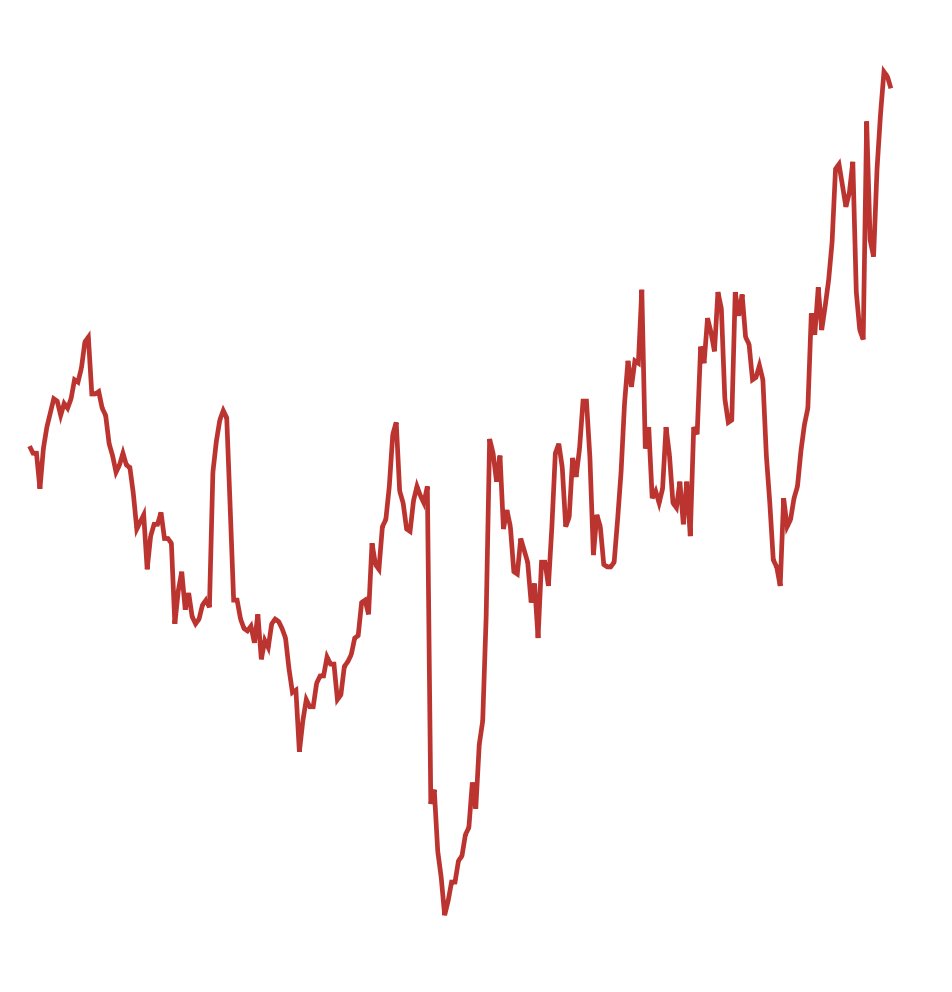
CDW, $171.65, is up 26% this year and 18% in the past twelve months.
$22 billion tech integrator CDW is serving as the “source of truth” in an IT market that is overwhelmed with choices, not just which AI stuff to use but how to make any of it do anything practical. That surge in activity is doing wonders for growth and profit at CDW, and CEO Chris Leahy sees demand enduring. “The cycles have compressed,” she says of tech buying. “There is a sense of urgency I have not seen before.”
This article was originally published November 16th for TL subscribers. For more articles like this, consider subscribing.
There is a $1 trillion figure that has dominated the information technology landscape all year long, being the estimate of the amount that will be spent by cloud and AI giants to build artificial intelligence data centers.
That number has been so obsessed over that it tends to obscure the fact that there is hundreds of billions of other IT spending going beyond just the six or seven biggest buyers.
Of that fact I was reminded in a chat last week with Christine “Chris” Leahy, chair and chief executive of technology integrator CDW of Vernon Hills, Illinois.
CDW, which began forty-two years ago as a reseller of computers, generates more than $20 billion a year of revenue off not just sales of computers, software and networking but also professional services, fees to manage cloud computing services, and from elaborate custom-engineered combinations of technology put together with partners. CDW is a modern systems integrator, a “solutions provider” as it’s known. The company has over two hundred fifty thousand customers in the U.S., Canada and the U.K., serving a market estimated at $450 billion annually.
People don’t realize things are changing under the surface of AI headlines, says Leahy.
“There has been a focus on the first wave of technology, the components, the hardware, the capacity building,” Leahy says of the surge in capital spending. “The next wave, where we’re at right now, which is putting technology to work, turning technology into everyday consumption, I would call it the second wave; it’s the wave that makes or breaks.”
She’s right, I think: the trillion dollars doesn’t mean much, ultimately, if it’s just a bunch of tech companies pushing it. What will make or break this moment is whether companies that CDW serves — airport, hospitals, schools, enterprises, government — can use this stuff for real.
ALL SYSTEMS GO
The second wave is going very well for CDW. After two challenging years in 2023 and 2024 in which large corporations worried about recession, scrutinized every tech purchase and took forever to sign a contract, the market is lifting CDW fabulously this year.
The September quarter saw sales rise by nearly 18% and the dollar amount itself was 9% above the Street’s expectations. That was the highest quarterly revenue upside in five years. The stock soared 13% on the report, contributing to a 26% return this year through Friday’s close of $171.65.
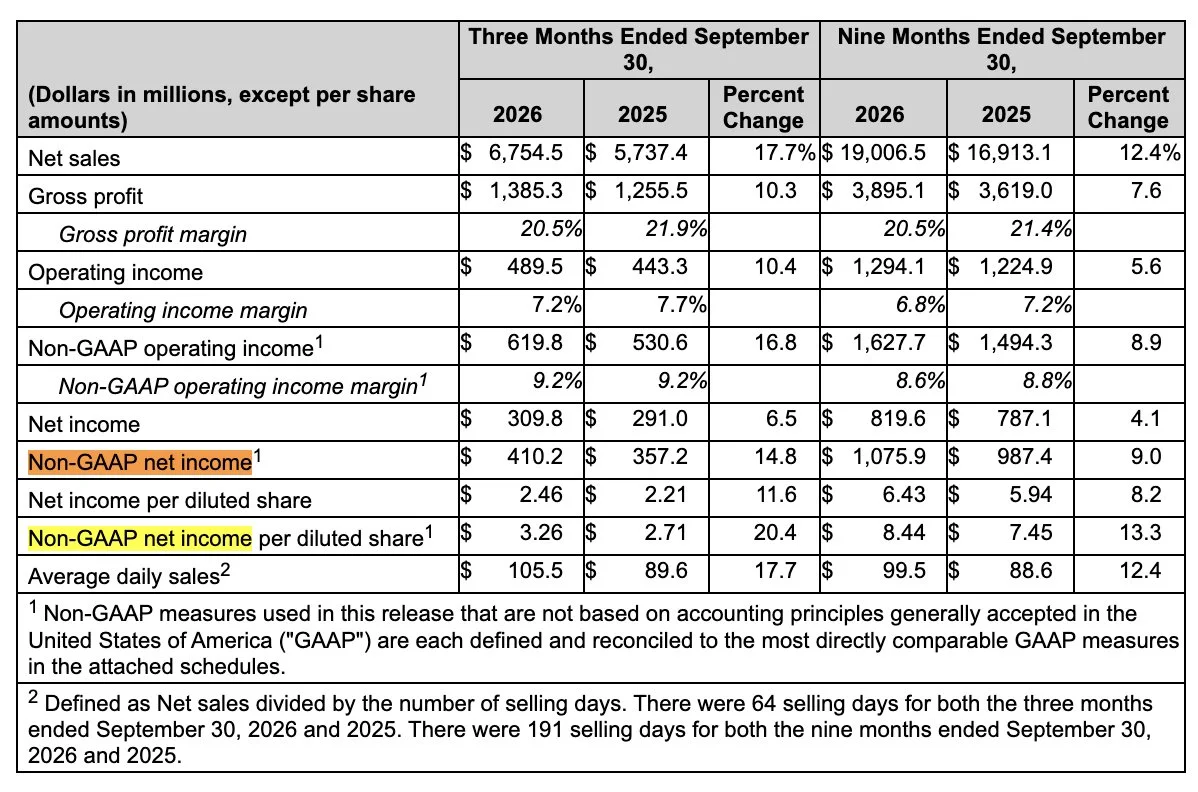
CDW’s third-quarter earnings results, November 4th, included health sales growth and profit growth.
Big growth produces leverage in the business. The company generally retains 20% or so of sales as gross profit, sometimes squeezing out a bit here or there. “We always want to ensure that we are driving the cost leverage,” she says, through favorable pricing and other “benefits of scale.”
Then, through expense control, gross profit flow down. “It’s important to emphasize that it compounded down the P&L,” says Leahy. The 17.7% revenue growth and 10% gross profit growth lead to non-GAAP operating profit growth of 16.8% and, finally, with the help of ample share repurchases, adjusted net income per share growth of 20.4%.

“The cycles [of IT buying] have compressed. There is a sense of urgency I have not seen before,” says Leahy. “It’s important to realize, these things are not linear anymore.”
Free cash flow also rose a very healthy 17.4%. Dividends and buybacks, combined, totaled $892 million in the nine months so far this year, equivalent to 114% of the $785 free cash flow generated. That is well ahead of a target payout of 50% to 75% of free cash flow that Leahy outlined in May.
Current yield on the dividend is 1.6%, which is in the upper echelon of tech payouts.
“The most important thing is that our model is durable, and it’s doing what it’s intended to do,” says Leahy. “It’s producing financial results, it’s driving customer stickiness.”
THE PACE IS PICKING UP
One question, of course, is, Can growth last?
Bulls on the stock are careful not to get too far out ahead. Following the upbeat report November 4th, Amit Daryanani of Evercore, who rates the stock Outperform, mused that the company could see sustained growth. “While we realize one quarter doesn’t make a trend there is a roadmap for CDW to sustain not just double-digit sales growth but show mid/high teens EPS/free cash flow growth over the next few years that could enable sizable re-rating,” he wrote.
But, Daryanani reiterated a price target of $185, just 8% upside from here, not very ambitious.
Leahy doesn’t set multi-year financial targets because the growth of the IT industry is something she can neither predict nor control. Her “evergreen promise” to investors is that CDW’s annual sales will rise by two or three points higher than the percentage growth of the U.S. information technology market.
Her forecast of that market this year has gone steadily higher, starting with a prediction in February that it would increase by “low-single-digits,” revised in May to mid-single-digits, and now projected at high-single-digits. On top of that, Leahy now says CDW can see an even bigger delta, three to four points of growth above that.
The sources of demand are across product types and technologies, she says. “When we look at cloud computing, security, data services practices, they are all hitting on high cylinders,” says Leahy. “All our leading indicators, our income, our invoicing, our backlog, are all extremely strong. Customers are not slowing demand in their priorities, including modernization and translating AI into outcomes.
It is not just the typical “re-fresh” that companies perform of their computers. Something about this second wave is driving broader efforts to combine technologies.
“It’s important to realize, these things are not linear anymore,” says Leahy.
Leahy, 61, is a twenty-four-year veteran of CDW. She took over as CEO on January 1st of 2019 and was appointed chair two years later. “The cycles [of IT buying] have compressed,” she says. “There is a sense of urgency I have not seen before.”
PUTTING AI TO WORK
The new urgency, she explains, comes from “a deep-seated belief that AI is fundamentally changing how organizations work, how children learn, how people consume.
“The kinds of conversations we are having, whether with school districts grappling with various points of view about technology in the classroom, how to ensure they have safe spaces that are conducive to education — they’re intensifying.”
Intense conversations go on with large enterprises to optimize what they do. A large airport in Texas wanted “zero outages” in the transportation systems between terminals to improve passenger experience, Leahy recalls. CDW “put together a solution that incorporated telemetry, LiDAR, hardware, software, data analysis, etc.” to predict equipment failure, she explains. The project includes “self-repair, self-correcting of operations.”
The same elaborate mixture of technologies is being brought to multiple industries, including healthcare. A model application of “agentic” artificial intelligence is “Patient Room Next,” built for a rural health system in upstate New York by CDW and partners. It uses not just the “frontier” AI models of the AI giants but also custom AI models the hospitals have developed. Sensors identify what’s going on in a patient room to reduce waste, but also to predict slips and falls based on how often patients are getting out of bed. It serves as a “virtual nursing command center.”
The project is already getting a return on investment, she says, including $7 million in labor savings in the first year, and lowering the turn-over of nurses from 25% to 13%.”
In all these ambitious projects, I can see the potential for confusion amidst complexity, and it’s interesting to me that Leahy emphasizes the role of CDW as a voice of calm. “We are the source of truth and confidence, and a sense of control,” she says. Technology is “not going away” and also “not getting easier,” she adds. “There aren't fewer choices.”
THE STOCK
Given the robust rates of growth and profitability and the sustained pace of capital returns, it is a wonder to me that the stock is actually cheaper than five years ago. On Thursday when we spoke, the current forward multiple of sales was 1.1 times, the current forward P/E, 14.3 times, down from 1.4 times and 23.6 times five years ago.
“I don't think that the P/E multiple is a reflection of the value that we deliver to investors over the medium to long term,” says Leahy. “That's a statement on both our overall growth prospects and our return on investment prospects for our investors.”
Although CDW shares have performed well this year, the three-year annualized return is negative 5% and the five-year is basically flat. What might investors be missing? I asked.
“If anyone’s missed anything … it would be the next wave,” she says, “the connection between all of the technology and the ecosystem, orchestrated, and working together safely, most cost-effectively, and doing what the business, the school, the healthcare provider, the government intends to be done, which is people consuming it for the outcome, not for the technology itself.”
I asked, facetiously, if Leahy cared to offer a target price for the stock. She’s very good humored, and she indulged the spirit of my ridiculous question with a sincere answer.
“I would suggest when you go back to 2020, when we evolved our services capabilities, which is a reflection of our expanding value with the customer, our stickiness to the customer, that will give you an idea of what I think we should shoot for.”◆
Disclosure: Tiernan Ray owns no stock in anything that he writes about, and there is no business relationship between Tiernan Ray LLC, the publisher of The Technology Letter, and any of the companies covered. See here for further details.